Showing posts with label Peter Cushing. Show all posts

Wednesday, 6 June 2018

Winter Chills - Part Four: Scream and Scream Again (1970)

I’ve been left on my own for five-and-a-half weeks...
What to do, what to do?  Well, for a start: I’m going to watch all those horror/fantasy/sci-fi films I’ve always been meaning to get to
… and write about them here!


From the sublime: last time's Cat People, to the ridiculous. I knew what to expect this time as I had seen it before when I was very young, with my favourite horror film fan: my Mum.
I think the violence disturbed me a little then, and to be honest, it still does. Many of the perpetrators are essentially synthetic which both nullifies the brutality a little - but also makes the acts even colder.

But lets not get too serious - this has Uncle Vinny, Sir Chris and The Cush all in the same Amicus film! That's got to be fun, right?
Well it might be if they shared more scenes. Lee really only pops in at the beginning, middle and end for some exposition, and Cushing is a mere cameo which appears to be a very early audition for Grand Moff Tarkin.
Needless to say, any bit of screen-time these gentlemen have is brilliant, but kudos must go to comedian Alfred Marks who crashes through the film as the most intentionally hilarious Bull-in-a-China-shop London Copper I've ever seen.

The main leads are the films' definite strengths - but the script seems to be three completely separate stories until they finally collide messily at the very end  - where various characters disappear into the same vat of acid.

Elsewhere, an endless chase involving what seems to be a superhuman Mick Jagger in a purple pirate shirt will test most people's patience, but now that I've written about this film I realise that I probably had a better time watching than it felt at the time.

I still can't decide what is the most disturbing thing about the random jogger, though: what happens to him in Price's hospital, or the length of his shorts and bewilderingly effeminate running style...

Monday, 4 June 2018

Winter Chills - Part Two: The Creeping Flesh (1973)

I’ve been left on my own for five-and-a-half weeks...
What to do, what to do?  Well, for a start: I’m going to watch all those horror/fantasy/sci-fi films I’ve always been meaning to get to
… and write about them here!


A Cushing and Lee team up which I hadn’t seen yet!  Neither Hammer nor Amicus, this is Tigon Production’s The Creeping Flesh.
And it almost does what it says on the tin. The giant inhuman skeleton Cushing brings back from New Guinea is not something any sane person would ever want in their house - and it’s much more terrifying than a Gremlin when it comes into contact with water.

Meanwhile Lee plays one of his most genuinely hate-able characters ever - and given his back catalogue that’s really saying something.
There’s a lot of genuinely good stuff here - particularly Freddie Jones’ direction - particularly in a very spooky sequence when the cloaked thing from New Guinea throws a huge Shadow across the house it is implacably approaching. 

The story elements of diagnosing evil as a pathogen, and the creepy ‘Elder gods’ vibe of the fossil’s origins are both fascinating, and either would flesh out (pun intended) a lesser film on their own. Unfortunately, this film doesn’t really capitalise on these strengths and spends far too much of it’s running time pursuing extras pursuing mentally-disturbed supporting characters through the town set.

Unfulfilled potential is always disappointing, but Cushing and Lee are as solidly dependable as ever here, in slightly different roles than we’re used to seeing them in. And we even get a brilliantly set up twist ending…


OK - if even he's scared it must be bad...


Friday, 23 December 2016

Tarkin it to the limit


This year has brought disbelief in many ways - but I never thought we’d reach Christmas 2016 with Peter Cushing trending on social media.


Seasons greetings, and apologies to anyone who actually does look in on this blog. I have been criminally neglectful of poor Phasmatodea, (3 years old this past October) in recent months.
Apart from ever-increasing work commitments (which is never an excuse) I have been commissioned to write a book.  Or more accurately, write, research, design, illustrate and lay out a book, which is obviously going to absorb my spare time until delivery date mid-next year.

I will post about it in more detail later, but in many ways it’s a culmination of what keeping this blog has prepared me for - trying to find new ways to discuss and analyse genre films which I’m passionate about. For now, I’ll simply state that the subject ties-in peripherally with the main topic of this entry. Let’s just say it’s going to be 'Hammer Time'...

Now back to this post. Since the ‘House of Mouse’’s acquisition of Star Wars in 2012 we’ve been promised a visit to a galaxy far, far away every year. And this December we got a ‘side-ways’ addition to the saga which I have to confess I never had high hopes for.
Rogue One: A Star Wars Story’s trailers seemed to offer a collection of cold and unappealing characters, and Director Gareth Edward’s last big budget film, Godzilla, actually made me think more fondly of the 1998 Roland Emmerich version.

I reluctantly predicted Rogue One would be an unsuccessful experiment in offering something new, outside the main Star Wars storyline., News of extensive studio-instigated reshoots made me think this might even damage the brand more than the prequels did.
The one thing which did keep my interest was the possibility of seeing one of my favourite characters, and actors, return to the screen - the late Peter Cushing’s Grand Moff Tarkin.

"...and I want proper images, instead of these screen caps, released immediately!"
Although initial, and to me very exciting, talk of a computer generated Peter Cushing seemed to go quiet, I kept hoping. Given the film’s setting immediately prior to Star Wars episode 4: A New Hope, I couldn’t see how Tarkin couldn’t be at least referenced. I cautiously expected that we might see a cutaway shot, (maybe manipulated unused footage from 1977), and perhaps a significant sound-alike line delivered. Glimpsed on a view screen or as a flickering hologram, something like that. Then no matter how bad the film was, I’d be happy.
The one thing I had never expected was that Tarkin would get more screen time and lines in Rogue One than when Cushing was alive…

The character has been posthumously represented for many years...
I’d never gone to a Star Wars film with low expectations before, and I left with my face aching from continuously grinning like a loon through most of the final hour. Let’s be clear, the first half is a little turgid and choppy, but the second is sheer TIE Fighter fuel. In its final act Rogue One felt to me like the most 'Star Wars-y' film since 1977, and unlike last year’s the The Force Awakens, the audience applauded at the end.

As far as Tarkin is concerned, it seems that those in the audience not in the know either don’t notice or wonder why this character was computer generated, while OCD Star Wars nerds either applaud the technical advancement or moan about video game rendering. And although some Cushing fans question the morality of digital resurrection, most seem rapturous over this respectful interpretation.

(Left to right) Tarkin from the Rebels animated series, Guy Henry, Tarkin from Rogue One and Peter Cushing from Star Wars: A New Hope.
My own expectations for the appearance of Tarkin were tempered - I knew it could never be perfect. Cushing was a tall man for his times but the actor who performed the role and wore later ‘wore’ the pixels; Guy Henry, is a good 3-4 inches taller. Cushing was also a master of ‘eye acting’, knowing how to use available light to make his pale blue gaze steely or compassionate where required - whereas in Rogue One the environment dictates that the Grand Moff’s eyes are more often in shadow.
But the biggest adjustment for me was not the visual, but the audio - because nobody else sounds like Peter Cushing.

It’s been said that in casting he and Alec Guinness in Star Wars, George Lucas inadvertently brought the best diction in the acting profession to his galaxy far, far away.  
Peter Cushing overcame a serious dental issue and his south counties accent to develop a cut glass voice which somehow found more syllables in words than anyone else suspected ever existed, decisively clipping them only after every vowel and consonant had been properly honoured. And he could roll those r-r-r-rs like no-one else not from Scotland can.
That being said, Tarkin’s most famous line, (beautifully honoured in Rogue One) urbanely draws the first word out without finishing it: “You may fa-h-h when ready.”
As far as Henry’s delivery is concerned, in fairness perhaps a slavish impersonation of Cushing would only sound like mimicry rather than a performance.

Wayne Pygram's makeup as a younger Tarkin in the closing moments of
Revenge of the Sith, (2005), was best seen from a distance.
Personally, I am delighted with the result and find it mind-boggling that when a digital recreation was finally attempted as a significant and sustained performance in a major film, it was done so with my favourite actor.

Last years The Force Awakens felt like an early Christmas present, But the last act of Rogue One makes you feel like a Star Wars fan finding everything you’ve ever wanted under the tree.

Merry Christmas, everyone!

"I cast him the first moment I met him.
There was no doubt in my mind that Peter Cushing was perfect for the role of the
sinister Grand Moff Tarkin... he was not only a very talented actor, but he even
looked the role – exactly what I imagined Tarkin to be."

George Lucas

Saturday, 27 February 2016

'Friendly' rival

Amicus, the studio whose name means ‘friendship’, was Hammer’s most notable competition in the British Horror film industry.


The brilliant documentary analysing Amicus horror, film by film, by fan Derek Pykett.

Hammer has instant brand recognition - Kate Bush never wrote a song about Amicus.  My experience of their films, as I suspect is many other film fans’, is reading about a Hammer film I once enjoyed only to discover it was actually made by their main rival.  


Having an even smaller budget than most Hammer productions, Amicus founded the concept of hiring actors on a by-day basis, rather than on contract for the entire film.  This meant that they could afford some impressive names - many of Hammer’s main players including the unholy duo of Cushing and Lee - and well-established British performers appeared to have no issue with filling in a free day here and there on an Amicus film.  The shorter segments of the studios many anthology films presumably also made this system so workable.

So the similar casts and genre meant it is often easy to confuse the output of the two studios.  In actual fact, there are many fundamental differences between the methodology and product of the two. 

One can only imagine how Milton Subotsky felt when his concept for remaking Frankenstein was rejected by Hammer studios, only for them to release their own version which propelled the studio to international horror film stardom.  The fact that he then set his own studio up in direct competition with them is perhaps a good indication.  
But my impression is that this rivalry was probably a one-sided affair, more of an issue for Amicus than it was for the Hammer juggernaut.

My own introduction to Amicus films came via two strong Doctor Who connections:
Their Daleks films from the mid-sixties, and a vampiric Jon Pertwee in The House that Dripped Blood.
I have room in my heart for both British Houses of Horror, but many insist on playing the two off against one another.  Sweeping statements are made when the two studios are inevitably compared (listen to Matthew Sweetman's expertly made but very Amicus-centric documentary here: http://www.bbc.co.uk/programmes/b03s9tm7) but having seen a lot of the output of both, I thought I’d analyse the oft-repeated ‘received wisdom’ for myself:

1. Unlike Hammer, Amicus specialised in anthology films

That's some cast , Amicus, and not an anthology film.
This one is true, although Amicus didn’t solely produce portmanteau films.  Milton Subotsky was strongly influenced by the first british horror anthology, Ealing studios Dead of Night, and after Amicus films first successful venture in this genre, Doctor Terrors House of Horrors, many more were to follow.  Their final horror anthology was From Beyond the Grave, coming full circle with once again featuring Peter Cushing as the innocuous seeming, but sinister, link between the different stories.  

Perhaps the closest Hammer came to the portmanteau form was an early and aborted American-made television anthology Tales of Frankenstein and their two 1980s British TV series.

2. Unlike Amicus, Hammer specialised in Period and Gothic settings

Stephanie Beacham in contemporary Hammer film Dracula AD 1972 and
 (inset) Period Amicus film And now the Screaming Starts.
Broadly, but not completely, true.  Hammer set their thrillers and comedies in contemporary times, and towards the end of their run Christopher Lee’s final two appearances as Dracula and the Valerie Leon vehicle Blood from the Mummy’s Tomb were all in a ‘modern’ setting.
Likewise, Amicus trod onto Hammers period pitch with their Doctor Jekyll and Mr Hyde adaptation I Monster, and 18th Century horror: And now the Screaming Starts.
In my opinion, they were all successful productions.

3. Amicus got bigger names than Hammer

Before he was a shonky animatronic puppet, the Crypt Keeper was played by
knighted British thespian Sir Ralph Richardson.
Possibly true. casting Sir Ralph Richardson, Joan Collins, Denholm Elliot, and the coup of having Cushing, Lee and Vincent Price appear in the same film, were all Amicus achievements.
Hammer tended to rely more upon an established repertory of accomplished performers, some of whom, like Christopher Lee, Stephanie Beacham, Oliver Reed and Joanna Lumley, became famous after their horror breakthroughs.

4. Hammer offered glamour, whereas Amicus was more about the uncanny amidst the everyday.
Many believe that Hammer can be distilled into sex and horror, flesh and blood which is a blunt, but difficult to deny, analogy.  In fact, Hammer stylishly presented these fundamental aspects in the form of an adult fairytale, morality plays where lines are clearly drawn and expertly performed.
By virtue of Amicus films' mainly contemporary settings, there is far less fantasy and stylisation in late '60s and early '70s decor and apparel. (But this can possibly be balanced against the casting of exotic screen beauties like Ingrid Pitt and Britt Ekland). 

5. Amicus gave (arguably) the leading man of both studios, Peter Cushing, more opportunity for range in his roles.

Tales from the Crypt: Peter Cushing certainly never got to play a zombie for
Hammer (or win an award for it!)
Given the wonderful character roles Amicus offered Cushing, including his award-winning performance in Tales from the Crypt, this is difficult to deny.  An actor of his skill can delineate Baron Frankenstein from Doctor Van Helsing, but it is far more subtle than the differences between Doctor Shreck, Arthur Grimsdyke and the Temptations Ltd Proprietor for Amicus.  To say nothing of his delightful Doctor Who.

6. Amicus ended with successful family-friendly fantasy adventures, whereas Hammer foundered with attempting to establish ‘Action Horror’.
This is a tragic example of bad timing on both sides.  It’s true that Amicus successfully managed a reinvention in the face of the decline of British horror films, turning instead to popular Edgar Rice Burroughs adaptations for the school holiday market.  In some ways, this was a return to the feel of their mid-sixties Dalek films. Sadly, the perhaps inevitable parting of the ways between Amicus partners Subotsky and Max Rosenberg ended the company and cut this resurgence short.

Hammer, in the meantime, more or less invented a combination of Gothic horror and action adventure with The legend of the 7 Golden Vampires, Captain Kronos: Vampire Hunter and the sadly unmade Vampirella, failing to find its audience at the time. The studio could not compete with the new wave of expensively-produced horror from the US and wound down. 
Four decades later, however, it’s sometimes hard to find anything else but big budget action horror at the cinemas!

Action horror is everywhere now, but Hammer invented the genre decades ago.

So let’s not fight, as viewers we will be the only losers in the end.  Better to open your heart to both - there’s no reason not to love the films from the Hammer House of Horror, and Amicus - the Studio that dripped Blood.

Saturday, 13 February 2016

Count Down: Addendum - Sound Bites

There are many different ways a not-so-classic film can be enjoyed...


“Peter Cushing immediately says:
“Who the f_ing ‘ell are you - where’s Chris? Chris!?
And Dracula (John Forbes-Robertson) says:
“Ah no, I’m playing the part of Chris this evening, Sir Cushing…”
And he gives him a b*tch slap!
He does… he gives him a proper slap! 
And Peter Cushing says:
“… I wouldn’t even take that from Christopher Lee,
so I’m certainly not taking that from you ‘ponce-boy’”,
- and he promptly kills him!”
(The climactic confrontation from Hammer’s Legend of the Seven Golden Vampires, not co-starring Christopher Lee, as narrated on the Hammered Horror Podcast)

I’ve recommended the brilliance of the Hammered Horror podcast before, effortlessly combining reverence and complete irreverence in their look at a broad range of horror films.  My favourite episode was their look at Dracula AD 1972 so when I heard they were doing the final film in Hammer’s Dracula cycle, Legend of the Seven Golden Vampires, I had high hopes.  Hosts Mr Ash and Mr Paul possibly had an easy task ahead of them in examining this notorious but glorious mash-up of Gothic chills and Kung Fu thrills (covered by me here: http://fasmatodea.blogspot.co.nz/2015/03/count-down-part-nine-asian-fusion.html), and they certainly didn’t disappoint.

(copyright the Hammered Horror Podcast)
http://hammeredhorror.com/index.php/2016/02/08/hammered-horror-33-the-legend-of-the-seven-golden-vampires/
At the end of their achingly funny and surprisingly informative podcast episode, Ash happened to mention that Hammer also released the soundtrack to this film as a story record in 1974, with Peter Cushing accompanying the film score with a narration of the story.

Quicker than you could say ‘Geek crack’ I tracked down a recording (I love you, internet) and have to report that it is absolutely delightful.
Story records at this time were, largely juvenile affairs, the sort of thing you would hear on the Sunday morning children’s radio requests programme - and apparently Hammer received some criticism for apparently trying to break into this market.
  
In fact,  this album is anything but. It’s a given that Cushing’s narration, with cut-glass diction and an ability to find more syllables in words than we mere mortals ever suspected existed, is superb.  James Bernard’s music, re-arranged for this release by Philip Martell, combines the disparate themes and settings of the film with skill and gusto, while writer Don Houghton refines his screenplay elegantly for ‘P Cush’s’ (As Hammered Horror call him) retelling.  Houghton’s wife and television actress Pik-Sen Lim even voices some dialogue as Maio Kue, the chop-sockying heroine who, although nothing new in Hong Kong cinema, could be regarded as a pioneering empowered female role model in a British film.

Complete with sound effects from the film , the care and attention which went into this record marks it as perhaps one of the earliest adult audio books - a market which continues to flourish today.  Even in their dying days, Hammer were once again at the forefront of entertainment.  Sadly, this is only one of two records which Hammer City Records produced, (more on the other in a post to come).

Like the film itself, re-releases have seen The Legend of the Seven Golden Vampires soundtrack album become better appreciated with the passing of time.  Also available on You Tube and Amazon, it only reinforces how ahead of their time Hammer was with their final productions, and how much more in step with current sensibilities films like this are now - over forty years later!


Monday, 1 February 2016

Assembly Line: Part Six - Days of Suture Past

“There’s nothing more for you to see. It’s all over now, all over…”

Baron Victor Frankenstein


Unlike the swan song of Hammer’s Dracula series, which ended with an outrageous experimental fusion of Kung Fu cinema and Gothic horror, Frankenstein and the Monster from Hell finished the Baron’s story with a return to form and the style of this film cycles’ roots, infused with an apt sense of melancholy finality.

Approaching 70, Legendary hammer director Terence Fisher was coaxed back for his final film. Anthony Hinds scripted this, his last Hammer (under his usual pseudonym of John Elder), and of course Cushing gave his last performance as the title character (could the Baron himself be the ‘Monster from Hell’?) Distinguished character actors from Hammer’s past like Patrick Troughton and Charles Lloyd Pack and Peter Madden were brought back for this farewell party, and even David Prowse, the only actor to play a Hammer Frankenstein creature twice, returned.

Copying from the best: The preproduction poster on the right, by Keenan Forbes, is clearly
inspired by Frank Frazetta's 1967 painting Nightstalker (detail on left).  But whatever its origin,
the art seems to have been the inspiration for the look of Dave Prowse's eventual costume.
Despite the fact that this was now 1974, and Hammer horror was fast becoming considered passé in these days of The Exorcist, Monster from Hell is a conscious return to the studios’ original style. This is evident in the fact that the gorgeous Madeline Smith, almost completely undressed in her previous Hammer appearance, is scrupulously covered from head to foot in this film and actually cast for her acting ability as the mute asylum inmate ‘the Angel’. A dialogue-free scene she shares with Bernard Lee ('M' in every Bond film up to Moonraker) is particularly impressive and affecting.

Madeline Smith (left), fully dressed but still acting her socks off.
It is a period setting, apparently an asylum some time in the Regency period - actually earlier than the previous films were set, but it works.

The Baron is sporting badly burned hands from his previous misadventure, however, leading to an infamous scene where he holds a wrist artery between his teeth while his assistant Shane Briant completes a hand transplant. Apparently Cushing’s idea, it perfectly conveys the Barons obsessive drive to achieve his goal, and become the ‘creator of man’

Frankenstein's cat really didn't like being wormed.
The fruits of his labours this time could barely be called a man, however. A hulking hominid creature, brought to life by 6ft 5-and-a-half inch David Prowse in a hairy semi-ape suit, this creation has been the target of some derision over the years. Despite this, the Baron’s last monster has become somewhat iconic, and has been represented in various kit sets and even an ‘action figure’.

Action figure and kitset model of the titular monster.
Apparently the Angel assembled him under the Baron’s supervision, so perhaps we have her to blame for the massive retrograde step in surgical skill.

Despite an unflinching amount of gore, the film is built solidly on the strength of its characterisations, none more than Cushing’s Frankenstein. Still very capable of action scenes, subduing the monster with chloroform while the much younger Briant just stands by, his descent into madness only becomes fully evident at the end of the film. Cheerfully sweeping up the mess while announcing plans for his next attempt, his assistants can only watch in dumb horror and disbelief.

There was never to be another attempt, of course. The Frankenstein film series was over, and shortly afterwards, Hammer themselves.

If David Prowse and Peter Cushing were disappointed by the response to their
first collaboration (left), their next film together gained slightly more recognition.
This film was not successful on its original run but, like many of it’s Hammer stablemates, has gained acclaim throughout the years. Perhaps because, although the values it embodies were outdated upon it’s release, this film perfectly encapsulates the spirit of the Hammer Frankenstein films, a beautifully directed and acted self-homage and epitaph, crafted by experienced veterans with most advanced techniques Hammer was ever able to bring to the screen.

Assembly Line-up

It's impossible not to make comparisons to Hammer's other great film cycle - the Dracula series.
As much as I love Christopher Lee's moonlit flits as the Count, it seems to me that the shorter Frankenstein series was more successful in bringing something new its own formula each time.
While the Count became a proto-slasher villain cypher, the Baron becomes increasingly more fascinating (if sometimes inconsistent). Cushing brings, and is afforded, far more range then Lee ever was as the Lord of Vampires.
I'll always be in the Hammer Dracula camp, but the quality and originality of the Frankenstein films has pleasantly surprised me, and I can now understand why many prefer them. 


The Baron clearly peaked in the middle of his career.

Creatures featured - by the numbers:

Appeared in Star Trek: 1
Appeared in Star Wars: 2
Were Decorated: 2 (plus Cushing was awarded an OBE)
From New Zealand: 1
Over six feet in height: 5
Appeared in Playboy: 1


Saturday, 16 January 2016

A New Heritage

It's (a longer) Hammer time...


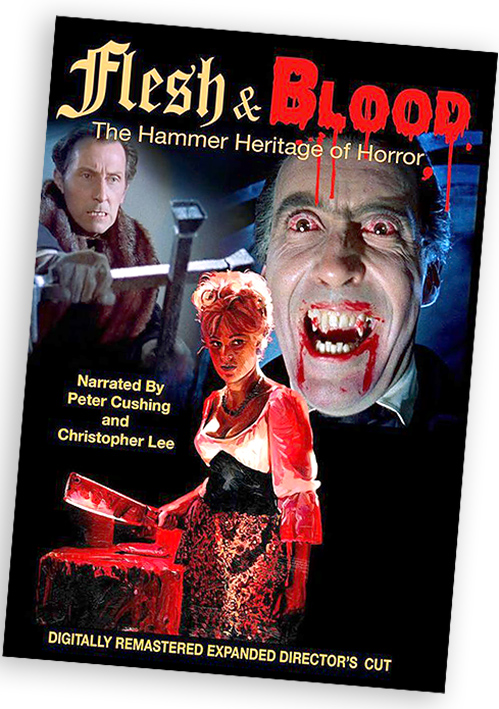
1994 was a significant year for Hammer fans. Peter Cushing cast off from his mortal moorings to rejoin his beloved Helen at last, and he did so between episodes of the best Hammer film documentary ever made.
Flesh and Blood; The Hammer Heritage of Horror was written and produced by film-maker and horror historian Ted Newsom, who brought Cushing and Christopher Lee together for what was to be the final time, to narrate it.

Peter Cushing, Ted Newsom and Christopher Lee at the
narration recording of Flesh and Blood in 1994.
During a tribute to Christopher Lee recorded last year, Newsom recounted that Cushing was very frail and ill by this time, and unsure he’d be physically able to perform the work.  Lee  sat down with him and regaled his old friend with anecdotes, reminiscences and impressions until Cushing was soon howling with laughter.  So much so that Newsom went from relief that aged actor was now re-engaged in the project, to concern that Lee would exhaust him too much to continue.

The resulting documentary was screened in two parts on british television, which I made certain I recorded, and re-watched many times, until it was released on DVD a couple of years later.
That disc then became the most replayed which I owned.


Flesh and Blood is exhaustive in the best possible way, and showcases fascinating interviews with everyone from Raquel Welch, to Joe Dante to a plethora of Hammer production alumni.
A lot of ground is covered with clips, trailers and behind the scenes footage, all of it woven together with the instantly recognisable voices of Lee and Cushing.
Although my collection of the actual films continues to grow, the authoritative history of the studio remained locked within that particular DVD case like a time capsule.  The final, definitive word, from the people who were there.

Together again, for the last time.
Or so I thought, until Ted Newsom signed off on last year’s Lee tribute with the news that he was finishing work on a new, expanded version of Flesh and Blood, remastered and remixed with additional material.  
I was instantly intrigued, but a little trepidatious as well  - could a perfect work really be made better - or merely longer?
Something convinced me though; his mention that an ingenious sound editor had remixed Cushing’s narration, the result knocking a couple of decades off the original, admittedly frail-sounding, delivery.
Like many others, I wanted to give Newsom my money there and then, but his experience with distributors in the past meant that he was only going to make it available himself this time, so we’d just have to be patient.
Happily, the 'new' Flesh and Blood became available at the beginning at the year, and I signed up, pleasantly surprised to receive a DVD-shaped parcel a mere week later.

The Flesh and Blood redux is a fascinating experience.  Aurally, Cushing does indeed sound like a more robust man in his 60’s rather than the ailing 85 year old he was.  I’m assuming pauses for breath have been removed and the voice deepened - but however it’s been done, to someone like me who knows some passages by heart, it’s a complete success.

The original Hammer's last gasps: an all-star Agatha Christie remake, their final horror
with a Dennis Wheatley adaptation, and the sadly unmade Vampirella.

Visually, the nearest experience I can think of is the feeling we had when George Lucas re-released his Star Wars films in the mid 90s. there’s an excitement to see the new material, where and how well it’s been integrated.  There’s no ‘Greedo shooting first’ nonsense here though.  Instead, Hammer on television and the new films have been welcomed into the fold, recollections are expanded upon, facts filled-in and and we even get to hear from fans the likes of Martin Scorsese and John Carpenter.

This 138 minute documentary is not only essential for anyone who takes their horror films seriously, but should also be treated as a serious historical account of a lost era of British cinema, and the impact of a single film studio on global popular culture.

Sometimes more is more.

(Flesh and Blood - The Hammer Heritage of Horror is available only through Paypal: Just type in act3prods@aol.com)

'New' Hammer has scored some hits like the atmospheric
and scary Woman in Black (2012)

Thursday, 10 December 2015

Assembly Line: Part Five - Young Frankenstein


Ralph Bates might have had a short career at Hammer, but he did land some plumb roles, positioned, (unsuccessfully), to take over from both Peter Cushing and Christopher Lee.


I looked at how Bates' Lord Courtley was supposed to cut in on the increasingly reluctant Mr Lee's vampire Count in Taste the Blood of Dracula here:
http://fasmatodea.blogspot.co.nz/2013/11/count-down-part-five-tasting-notes.html

This strategy was scotched by American co-financers and distributors Warner Bros, who insisted they were putting their money in to see Lee as Dracula.  In Horror of Frankenstein, Ralph Bates then moved in on  Hammer’s other icon and took the lead in a film which was to reboot the popular film series, beginning with a quasi-remake of Curse of Frankenstein.  But this time it appears that the public voted with their feet, the only Baron they wanted was Peter Cushing.

For Bates it was to be third time lucky, playing the last of his trio of iconic horror Characters, Doctor Jekyll, opposite Martine Beswick's Sister Hyde in 1971.

But neither of his previous efforts were his fault, Ralph Bates does as excellent a job as ever in Horror of Frankenstein (1970), despite having hair almost as big as the two lovely female leads, Veronica Carlson and Kate O'Mara. In fact in direct opposition to everything I'd always been led to believe, it is hard to find any real deficiencies with production.  Despite the impressive décolletage on display this is not Carry On FrankensteinMad Doctor at Large or even Monster About the house.  But the weakest element does remind me inescapably of another famous British comedy series:

"I didn't get where I am today..."
Really, resembling the immortal CJ from The Rise and Fall of Reginald Perrin might be Dave Prowse's greatest achievement in this film.  The disturbing and somewhat deviant fact that the 'monster' is nothing but a body-builder in a bald cap, dog collar and nappy just can't be overlooked and only makes Christopher Lee's achievement of emoting through several layers of mouldy pudding in the 'original' that much more remarkable.

If I'd have to make a guess at why this film is not considered a success it would have nothing to do with the cast, or even the script but the intention of the film.  The earlier films in this cycle succeeded because the essence of Mary Shelley's novel was interpreted by Hammer with their first film, freeing up the ensuing chapters to explore innovative new directions in storytelling (perhaps with the exception of Evil of Frankenstein - tailored specifically  for Universal to emulate their original films).
Horror of Frankenstein gives us a bright new cast and a more modern sensibility, but unfortunately feels the need to tell the original story yet again.  Apart from this repetition, the re-stitched plotline also depends intrinsically upon a 'creature' whose deficiencies have already been mentioned.

Cushing would know what to do...
A new series of Frankenstein films starring Bates was not forthcoming, but lets close by focusing upon an important success.  The previous two cinematic outings for Cushing's Baron had been gradually establishing more central roles for women, but here we have the epitome of that shift.  Kate O'Mara and Veronica Carlson (her second Frankenstein film in a row) have as much screen time as their male co-stars and easily as much significance to the plot.  O'Mara relishes in her vampish role: Alys showing a ruthless streak of her own when her livelihood is threatened. And Carlson brings depth and conviction to what could too easily have become merely an over-virtuous polar opposite to O'Mara's earthy and mischievous housekeeper.


Horror of Frankenstein is a worthy experiment, but like the results of the Baron's own researches, is only a partial success: a product of great skill but somewhat clumsy, misshapen and unfairly shunned by those who don't understand its intent.

"One day I'm going to play the most famous villain in film history!"
"Sure, Dave..."

Tuesday, 29 September 2015

Assembly Line: Part four - Hertz and Soul

Forget the previous films - again.  This time the Baron is not the villain, only a chilled cat in the mood for some soul.


In Frankenstein Created Woman, once again the idea of Hammer's Frankenstein films forming a coherent series is challenged. Cushing's Baron is an altogether less malevolent and ruthless figure here, apparently more concerned with the consequences of his experimentation. Not only that, but he seems to have gone a bit 'emo', now fixated upon metaphysics and the human soul rather then the charnal house raw material of his usual stock and trade.
And full marks to Hammer for trying something new.  The Frankenstein series may be far less consistent in over-arching narrative their Dracula sequence, but turn this to their advantage by telling a greater variety and style of stories.


The Baron also appears to have lost the use of his hands, which remain gloved throughout the whole film (and even while carrying Susan Denberg around in those iconic but mendacious publicity shots).  Frustratingly, a single line of dialogue could have explained this sudden disability, and the climax of the next film certainly does, but it's a major plot point simply left hanging.
The justification for it is clear enough, however: Frankenstein wouldn't need to rely on Thorley Walter's bumbling Dr Hertz if he was physically whole, and he certainly wouldn't need someone else's Hans.

The real surprise is the way that the production treats Polish-born Susan Denberg. Despite those bandage-bikini promotional images, Hammer had yet to hit it's early 70s exploitation period, and they actually give the August 1966 Playmate a challenging acting role - a dual role, no less. Not only that, but the supposed physical unattractiveness of her initial character is also intrinsic to the plot of the film - refreshingly unpredictable writing for a beautiful up-and-coming actress. As the disfigured Christina, Denberg is an extremely sympathetic figure and her relationship with Hans is touching but ultimately tragic.
The vile intercession of three proto-Clockwork Orange privileged thugs (one of them played by a young Derek Fowlds prior to Basil Brush) begins a series of events leading to the deaths of the two innocent lovers. It also provides the Baron with a fresh female cadaver, and access to the guillotined Han's soul.

Hans regards the three sadistic Toffs warily.  Basil Brush's friend Mr Derek is on the far left.
The Baron takes care of the tricky soul transmigration business, while Hertz is able to surgically cure Christina of her previous physical ailments (which quite naturally has the side-effect of turning the previously dark-haired girl blonde.)
The result is a revived and child-like woman who unfortunately shares her perfect body with the vengeful soul of her unjustly-executed boyfriend.
Seduction and gruesome murder soon follow ...


So, there is far more to this story than the simple 'Frankenstein creates a female monster' direction which the publicity encouraged us to expect. Of all the films in this series, this one sidelines the Baron the most, the major villains being the trio who earn Christina/Han's bloody revenge, but Cushing does get a brilliant entrance and then proceeds to enliven and enrich any scene he appears in, as usual.

The Baron finds himself having to depend upon Thorley Walter's Dr Hertz.
Famously, Martin Scorsese picked Frankenstein Created Woman as part of a 1987 National Film Theatre season of his favourite films, saying: 
"I like all Hammer films. If I singled this one out, it's not because I like it the best - it's a sadistic film, very difficult to watch - but because, here, they actually isolate the soul: a bright blue shining translucent ball. The implied metaphysics are close to something sublime". 
Quentin Tarantino is obviously also a fan, owning one of the only 16mm prints of Frankenstein Created Woman.

This was to be not only Susan Denberg's only role for Hammer, but her last film.  A victim of early show business success and late sixties drug culture, she suffered a major breakdown and was hospitalised shortly before she was to star in the film which made replacement Marianne Faithful famous: Girl on a Motorcycle.

Avoiding attention and publicity to this day, Susan Denberg's iconic association with this film has never-the-less given her lasting fame in the Hammer house of horror.

Susan Denberg with her co-star in happier times.

Saturday, 15 August 2015

Assembly Line: Part Two - Changing his Mind

Freed from the shackles of Shelley's original tale, Hammer's Frankenstein comes into its own with... a cannibalistic chimpanzee called Otto and a 'monster' which looks like Michael Palin?


Revenge of Frankenstein (1958)

This film is not just a sequel, but really 'the' sequel, establishing Hammer's tradition of continuing franchises. 
And unlike the original Universal Frankenstein series which followed the adventures of the monster, the Baron himself is our main character in this and the following films from Hammer.
Made back to back with Dracula and sharing some of that film's sets, Revenge reunites almost all of the production staff from the first Frankenstein film. Narratively, it dovetails perfectly, literally continuing from the last scene of Curse of Frankenstein in a superb pre-credits sequence.
As much as I love lobby cards , this hand-coloured example is an affront to the careful and striking colour used in the actual cinematography.  Cushing certainly doesn't wear a purple one-sie, for a start.
The Baron's escape from the guillotine isn't spelt out, but gradually revealed through the first part of the film and is in fact crucial to the plot of this film.  Amazingly for a script which was apparently stitched together with undue haste, Revenge of Frankenstein is one of the best written and most tightly plotted Hammer films I've so far seen.
Cushing is in brilliant form, posing as a certain Doctor Stein and running a very successful practice, stealing patients from established GPs and body parts from the poor he purports to be helping. All the while urbanely disdaining the jealous establishment and focusing on his sole obsession of creating life.
His skills certainly appear to have developed, instead of Christopher Lee's 'walking road- kill' the 'creature' this time does appear to be physically perfect, barring some careful suturing and an uncanny resemblance to a young Michael Palin. It is also an empty vessel, awaiting hunchbacked, malformed assistant Karl's brain - allowing him a new life in an healthy body. All goes well, until it is noticed that the previous test subject, Otto the chimpanzee, has developed cannibalistic tendencies since his own transplant...

Lucy the Chimpanzee with co-star Peter Cushing
Michael Gwynne's portrayal of the tragic Karl 2.0, deteriorating not only physically, but mentally, is very affecting and makes up for the absence of a more recognisably monstrous creation. In fact, on a psychological level, he is a far more frightening figure.
"Thwow him to the gwound, Centuwion - vewy woughwy!"
Apart from a depressing, but thankfully brief, veer into sadism, this film is a surprisingly classy production, dependent more on exquisite performances and well-woven drama than the gore this series is more readily associated with.
And the twist ending is a master-stroke.  If anyone was to wonder what becomes of that arm adornment in future films, I'm sure the Baron's skills are more than equal to the challenge of tattoo removal.  I hope the next films are at least half as good as this one. 
Doctor Stein and Doctor Franck - no relation.