Saturday, 28 February 2015

One to beam up

Leonard Nimoy lived well and prospered


Leonard Nimoy: 1931 - 2015

Created the same year I was, I literally can't recall a time before Star Trek. It was another show we watched as a family and at my earliest age I suppose, like Doctor Who, it was the monsters and aliens which appealed to me.  But here's the thing: Star Trek had an alien who wasn't just another marauding invader, he was part of the crew.  He was one of the good guys.

It is so taken for granted now but this single concept defined and elevated Star Trek beyond anything which had gone before.  Network executives were rattled and demanded the character be removed, but creator Gene Roddenberry put his job on the line.  He knew what he was doing (this time, at least). His show was to (sometimes rather earnestly) address the issues facing multi-racial America in the 1960s through the lens of a more-advanced future. And what better way to do that than to have an inter-dependent community which featured an Asian, an Afro-american woman and , to really drive the point home: someone who wasn't even from Earth?


The rest is well-trodden history - Mr Spock became one of the most recognisable figures of the late 20th century and continues to be so. Despite his obvious exotic pointed eared appeal the plot device of his mixed heritage and constant inner conflict between his logical Vulcan and emotional human sides was a stroke of genius.  A tormented hero who could potentially embody the best of humanity and most enigmatic of alien couldn't fail to appeal to every demographic.

I certainly took to Spock straight away. Despite not being remotely cerebral myself I've still always identified more with the controlled and learned Mr Spocks of fiction than the two-fisted Lothario Captain Kirks.  I quickly taught myself the Vulcan salute although my left hand, as Nimoy himself quipped, speaks it with a slight accent.  And I used to pedantically bristle when well-meaning adults used to confuse the character with then in-vogue childcare specialist Benjamin Spock - and refer to the Enterprise's First Officer as 'Doctor Spock'.

I think Spock taught me most of all that it's always best to keep your cool.  Infinitely harder, but ultimately better.

Leonard Nimoy was one of the first actors whose names I learnt - his surname, of Ukrainian Jewish origin, even sounded alien. When science fiction had it's global  Star Wars-propelled renaissance in 1977 Star Trek seemed to be never off TV, but I seem to recall while at school in New Zealand it was actually the animated series which was most broadcast.  And naturally, this placed more emphasis on the actors voices: Nimoy's sonorous tones gaining a stardom of their own.

The animated series: A two dimensional Enterprise crew
jog cross a very small planet

That instantly recognisable voice ruled the airwaves with Nimoy's long-running In Search of series, and I remember watching him in Mission Impossible as Paris, the disguise expert member of the IMF team.

Cravats are... illogical

A Star Trek film was inevitable, and perhaps just as inevitable was Nimoy's reluctance, (being perhaps the actor having most success after Trek) to return.  A replacement Vulcan was even cast but, despite having just written an autobiography entitled I am not Spock, Nimoy was once again - nine times again in fact, including an appearance on The Next Generation TV series and further films right up to 2013's Star Trek: Into Darkness.

'Spock Prime': "No Quinto, you do it like this..."
During this time he directed films (including two of the Treks), wrote poetry, published books of photography, performed and gave talks on stage, lent that voice to many different franchises including TransformersThe Big Bang Theory, The Simpsons and , most notoriously, recorded songs.  Reuben Jane will never sound the same for me...
Leonard Nimoy died at his home on February 27, 2015 of pulmonary disease, at the age of 83.


"We are assembled here today to pay final respects to our honored dead. 
And yet it should be noted, in the midst of our sorrow, this death takes place in the shadow of new life, the sunrise of a new world; a world that our beloved comrade gave his life to protect and nourish. He did not feel this sacrifice a vain or empty one, and we will not debate his profound wisdom at these proceedings.
Of my friend, I can only say this: Of all the souls I have encountered in my travels, his was the most... human."

(Star Trek II: The Wrath of Khan)

Saturday, 21 February 2015

Rule of Thumb


When Douglas Adams heard John Cleese decide that 42 was the funniest number he could think of, who could have guessed where it would eventually lead?


Despite the surprising but still profound disappointment of the film version ten years ago, The Hitchhikers Guide to the Galaxy will forever hold a a special place in my heart.

In distant 1980, my English teacher scrawled at the bottom of a review I had written for a Doctor Who novelisation that he had a book which I might like to borrow.  It turned out to be Douglas Adam's sequel to HHGTTG - The Restaurant at the End of the Universe, and I might have devoured it in a single sitting, before quickly buying the first book for myself.

Where it all began for me: not at the beginning - but the end of the universe...

Of course, this wasn't to be the first intersection of Who and Hitchhikers for me.  Earlier that year I had thoroughly enjoyed a serial called The Pirate Planet, obvious even to a fourteen year old me that the script was a blazing star of imagination, wit and fascinating characterisation super-condensed to fit (barely) into a BBC budget. In a story featuring time dams and barely harnessed titanic forces crushing the remains of plundered planets into football sized husks - writer Douglas Adams' imagination was similarly only just held in check by the not-inflexible format of Doctor Who.
It was obvious his vision needed more room and, in a typically extreme application of sod's law, the once 'rejected to the point of near-suicide' writer was finally commissioned to write the first radio series set in his own Galaxy at the same time as The Pirate Planet was green-lit. (Adams's continued and controversial association with Doctor Who is another story, but most fans these days agree that we were unimaginably blessed to have a genius of Adams's stature writing and script editing our little show, whatever the results).

They were never able to pay Douglas Adams enough to novelise his Doctor Who scripts, 
but I was at least able to illustrate the stories for various purposes:

I caught the very end of the first NZ broadcast of the Hitchhikers' radio series, recording and playing the episode featuring 'the man in the shack' and his cat over and over again.  The books brought the imagination, but radio delivered the wonderful performances of Simon Jones, Mark Wing-Davy, Stephen Moore and that unforgettable theme music.  Often called Eagles-like, probably because Journey of the Sorcerer was actually written for their last Album before the breakthrough Hotel California, and chosen for Hitchhikers because it has a banjo in it.

My Hitchhikers experience escalated - a friend bought me the record album of the Restaurant at the end of the Universe and finally, in 1982, TVNZ screened the BBC television series.  It's ironic that Douglas Adams revelled in the freedom that radio gave him to create vast and incredible visions, only to have its success demand that the BBC then find a way of realising the visuals after all.

Radiohead - the TV series' most notoriously unsuccessful, 
but affectionately regarded, special effect.

Results were mixed (the mighty Vogon constructor fleet inexplicably became a single ship) but the shortfalls in budget somehow suited this terribly-British collision of the everyday and Inter-Galactic which is at the heart of Hitchhikers (and perhaps another reason why the heftily budgetted movie didn't work for some of us?).  Like much of British TV, (including Doctor Who), it was the performances and writing which carried it and endeared Hitchhikers to a new, and surprisingly mainstream audience. As with every iteration of HHGTTG, Adams varied the story, apparently to stop himself getting bored, but the programme has a feeling of definitiveness unrivalled in any other incarnation.

Real computer graphics were nowhere near this good back then, and often aren't even now.

Perhaps it's due to so many of the original audio cast taking part, although the TV series has a splendor all of its own: the genius of the 'computer' graphics (actually hand-drawn animation) accompanying the Book's lengthy monologues and the instant-classic opening featuring the hapless spaceman hurtling through the letter 'O' in the title.


And it was here that the unmistakeable image of Arthur Dent forever clad in a dressing gown was created - against his creator's wishes.

The motley crew of stolen spacecraft; The Heart of Gold

Even back then, there was talk of a film version, Adams eventually pulling out when he realised that all the American backers really wanted was 'Star Wars with jokes'.  We fans have always known that Hitchhikers was never really about the science fiction. That was simply a backdrop and facilitator for Adams's wry observations on the absurdities of 'normal' life -  in much the same way as Jonathon Swift satirised his own culture within an epic fantasy (following another hapless traveller - Gulliver - through strange lands) hundreds of years ago. Incidentally, those same American film-makers then pursued their own sci-fi/fantasy idea, which resulted in an obscure little effort called Ghostbusters.  (How very Adamsian for a film covered a couple of blog posts ago to turn out to be connected to the subject of this one)

 Trillian and Marvin - 1982: Sandra Dickinson and Stephen Moore; 
1985: Zooey Deschanel and Warwick Davis (unmistakeably voiced by Alan Rickman)

So - about that movie which eventually did get made twelve years later...  Well, sticking John Malkovitch in anything instantly makes the glow of a texter's cellphone more captivating to me, but the film still had it's moments.  Zooey Deschanel gave us a more proactive take on Trillian, and Bill Nighy's performance and scenes as Slartibartfast lift the entire production. (He could be the best of three brilliant interpretations of the character I've seen - including Richard Vernon in the TV series and my 6th Form classmate Warren Hall.  His backing out of the geography room, protesting feebly about Fiords and waving a roll of dusty Education Board maps, trapping them in the closing door with perfect timing, had me in stitches).
As the books continued I lost interest when my favourite character, Zaphod Beeblebrox, was written out.  Similarly the further radio shows, interactive computer games and comic adaptations all passed me by.

The TV series remains the genuine article for me. I last experienced it on VHS, comforted by the first few episodes while I lay on a friend's sofa, suffering as never before from a post-Pan Galactic Gargleblaster-scale hangover. I somehow think that Douglas Adams, or at least his reprehensible and much-loved characters, might have approved.

Bidenichthys Beeblebroxi, a newly discovered New Zealand fish 
named shortly before Adams's death.

The great man himself passed away in a Santa Barbara gym in 2001, towel in hand at age 49.  The excellent biography by Jem Roberts which I've just finished and inspired this post, sums up such this tragically early loss better than I ever could:

"Dramatically, it just doesn't work at all; it was just wrong, and has felt wrong every day since.
His end was not a 'pleasing punctuation point' or an ironic fate, it was a sudden and totally unwelcome random event in a universe which, by its very nature, only exists because it makes no sense at all."


Douglas Adams: 1952-2001

Friday, 13 February 2015

Count Down Part 8: Last Rites

This instalment finally saw Christopher Lee out for the Count.


The Satanic Rites of Dracula is not a bad film.  It is probably the most exploitative of the Dracula cycle so far, and certainly contains an odd mash-up of plot devices and themes.  Motor cycle gangs, espionage, black magic, nudity and an insane plan to end the world all collide in a film which is possibly most kindly described as James Bond meets Dracula.

Oi - pack that right in!  Christopher Lee reaches the end of his patience
with his most famous role.

Cushing and Lee together, in their two most famous Hammer roles was always going to be a draw card. Incredible to think that they first played Van Helsing and the Count Dracula in the last years of the 1950s, and now the mid-1970s were fast approaching.  All trappings of a central European, nineteenth Century setting were now completely gone and instead the same delirium which possesses filmmakers into thinking that updating remakes to present day is a good idea held sway.  Tomorrow may never come, but the ‘present’ is even more ephemeral, and what once was contemporary can instantly date and end up looking far more ancient than a Transylvanian castle.

Insert your own 'Ab Fab' gag here.

To look at the positives first; we have a very young Joanna Lumley, replacing Stephanie Beacham from the previous film, as Van Helsing’s granddaughter, Jessica.  Soon to be the intrepid side-kick to another excellent British actor of the old School, Patrick MacNee, Lumley throws herself into the increasingly outlandish proceedings with convincing sincerity.

Insert your own New Avengers gag here.

Van Helsing himself has become the Grand Moff Exposition, laying down supernatural lore for Scotland Yard.  But yet again, Cushing’s full commitment to every role he played elevates the character above this rather gauche attempt to write him as a mere cypher. A sequence where he skilfully fashions a silver bullet illustrates Cushing’s attention to detail: it was always part of his belief that becoming completely familiar with any procedure he had to perform on screen would better convince the audience of the reality of a scene. Lorimer Van Helsing is once more a fascinating mixture of steely determination and courage, blended with compassion and ageing vulnerability.

Nothing up his sleeve: Peter Cushing is making
doubly sure with silver bullet and crucifix.

On the opposing side, Christopher Lee isn’t given much more to work with either.  But having said that, there is a scene where he gets to play a Bond villain, DD Denham, sporting an odd Slavic (Lugosi?) accent while his true identity is hidden by, umm, a drawn curtain.  Although this is a direct sequel to the previous film, for once there is no resurrection scene, the Count simply appears half way through the proceedings to carry off another victim.  Seeming a little out of place in this casually violent and sometimes misogynistic ‘contemporary thriller’; in all honesty it isn’t difficult to see why this film was the final straw for Lee. Ironically, ‘Satanic Rites’ was intended to be the final straw for Dracula as well, his diabolical master plan being essentially an elaborate suicide attempt – by wiping out humanity he will also destroy his own means of survival.

A shrub-based ‘death scene’ at the hands of his perennial nemesis at least sees the Count, and Christopher Lee's definitive portrayal of him, out in some style. Hammer could have conceivably brought this once-great film series to a close here - leaving Bram Stoker’s creation with some dignity still intact.

Crowned by thorns: The Count runs foul of another religious icon,
and his final disintegration courtesy of Hammer effects wizard Les Bowie.

Alas Hammer Head Michael Carreras’s well-intentioned drive to inject new blood into the by-now failing Hammer studios had one final insult in store for the Prince of Darkness.


Friday, 6 February 2015

Odd Man In

Men were forbidden to set foot on the secret Isle of the Amazons,
but I once lived in their halls of residence.


My door was smeared with what I hoped was just honey, with tea leaves mixed into it.  Failing to get into my room without getting the tarry residue all over my hands, I quickly found there was worse to come. No object had been left unscattered or upright, no surface unlittered, no bed sheet not redistributed to an unlikely location.  Suspended above what was left of my bed was another sheet, forever ruined by the same sticky mixture.  But the letters it formed made any possibility of outrage at this violation impossible: "We'll miss you…".

My room: crime scene and perpetrators
Any chance of spending my last night at the Wellington Hospital Nurse's Hostel peacefully, or packing with any kind of efficiency the following morning had been sabotaged as thoroughly as my room. But I was moved by the effort and sentiment shown and spent my final few hours as a hostel resident happily with the perpetrators, before dragging cushions out of the TV lounge to try and catch some sleep in the conservatory.  (Had I been less tired I might have heard the quiet invitation to spend my last night somewhere more comfortable, but despite having huge ears this wasn't to be the last time I'd miss an opportunity by not paying attention).

A whole summer ago I had returned to Wellington for my second year as a hostel resident to find that what had to be a colossal administration error had taken place.  Instead of returning to the men's quarters where I had spent the previous year, I was now placed on a floor with thirty young female nursing students.  There was a degree of justified envy from my former floor-mates, but what could I do - breaks like this didn't come my way (or possibly anyone's way) very often.  I'd been educated at a single sex college, and was self-aware enough to realise it had done my social skills no good at all, so this was an opportunity.

Circa 1940: The original Nurse's hostel building (Later becoming the male residence
where I spent my first year.  What was to become my room in forty-four years time is
indicated with an arrow, at the far right. (Collections  1/2-037267-F)
And speaking of self-awareness, let's be clear on one point.  This was no male fantasy made real - my limitations were as apparent to my new neighbours as they have always been to me.  I might have spent most of my time adolescently love-struck, but to them I was tolerated, at best humoured and mainly capable only of attracting sisterly or even maternal affection.  Sometimes I felt like a harmless curiosity (they were all studying nursing, I was a design student), occasionally I was the comedy relief (a formidable young woman across the hall liked to bellow "Warm my bed, Boy!" at me in the evenings) and sometimes I was even an agony uncle.  Having almost no life experience of my own, I had little advice to offer so unwittingly possessed a vital skill and accompanying revelation which many males will always struggle with - often women just want to be listened to.  I was everything except a romantic possibility, but I was fine with that - I was happy just to be there.

But I learned quickly that not everyone appreciates cheerfulness first thing in the morning and also discovered first-hand confirmation of the phenomenon of syncronising biological cycles - which for me could be akin to picking my way through the middle of a vast minefield for a few days each month. Mainly, however, it was blissful. Most of us are happy to get home after a hard day, but imagine how much better it is to step out of a lift and be greeted by a TV lounge full of beautiful women.

Often I was company for someone coming off a late shift on the wards who was still 'buzzing' after a busy night and didn't feel like going to bed yet.  My course workload was brutal and so my light was on most hours. There would be a quiet knock at my door and a bright face proffering tea and toast for two would appear, who'd then sit and chat until sleepiness set in.

February 2010: The demolition of the old nurses hostel. The main (women's)
 residence, Riddiford House, can be seen behind. (Photo: Phil Reid/Dominion Post.)
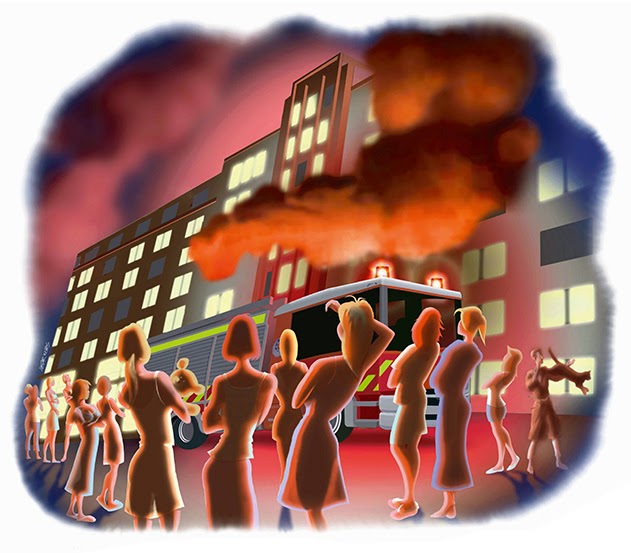
I was occasionally the target of good natured practical jokes, but decided I'd had enough when I was woken up at 4.00am by someone loudly knocking and shouting that there was a fire.  I flung my door and mouth open to express annoyance and instantly choked on smoke.  It was for real.  I say I wasn't viewed as a romantic possibility by anyone but by the middle of the year had begun a rocky relationship with a Nursing student at the other end of the corridor.  I ran straight to her room and swept up into my arms... a cat.  How we came to illegally harbour a lost feline is another story, but I wanted to get the poor animal safely out of the building. The fact that I expressed more concern for the cat than the room's other occupant probably goes some way toward explaining this relationship's rough edges.  The excitement proved too much for the startled creature as I carried her down the fire escape and she clawed my face in fright before fleeing into the dark.  At least she was safe.
When the firemen finally arrived they must have thought their dreams had come true as they pulled into a car park packed with nursing students in their flimsy nightwear.  Oh, and some weird guy with a bleeding face.  The ‘blaze’ turned out to be a minor incident involving a discarded cigarette and a cushion, and we finally all trooped back in as dawn was breaking.

Just another night at the nurse's hostel?  Well, not quite.  As I'd stood in that car park with a trickle of blood running down my cheek, a new girl appeared through the crowd and gently dabbed it away with the sleeve of her dressing gown.  She had not-long moved in next door to me and all these many years later still picks me up and dusts me off when I need it.  I like to think I've done a passable job of looking after her throughout our married life, too.

I trundled my belongings on a borrowed hospital trolley through the sunny Newtown streets to my new flat at the end of that year, a very different person to the one I'd been when it began.  The comforting, cream, art deco monolith of the Nurses Hostel, a better centre of learning, self-improvement and opportunity than anywhere else I've ever attended, receded into the distance behind me; but will never be forgotten.  Whether I really had been given that particular room by error or design, I remain forever grateful.

April 2012: The carpark has been extended but the 63-year-old main residence,
having long since extended its hospitality to low income residents, Cook Strait
ferrymen and overseas restaurant cooks, faces closure for structural strengthening.

Thursday, 29 January 2015

A New Hope

With Star wars returning to our screens later this year, I thought it might be timely to dust off this fiction piece I wrote a long time ago in a country far, far away; when both the franchises combined in this story were very much in dormancy.


A blazing band of stars silhouetted the recent arrival's profile against the viewing port.
The scale and beauty of space was a sight that no one could ever really grow accustomed to, but he had given up being just a watcher a long time ago.

And look where that had got him! The Doctor sighed heavily and leaned against the corridor wall, burying his hands even deeper into his pockets. He had always hated being kept waiting, and his irritation with Them wasn't helping.
"Botched Dalek mission", indeed!
The "some good coming from great evil" line hadn't gone down too well, but he'd like to have seen them do better. And even now, the Doctor had a nasty suspicion that he had been manipulated again, provoked into accepting this "one last task" as a challenge. Sometimes he wondered just how corrupt the Time Lords really were.

In all honesty, however, he might have agreed to take this one on without any persuasion.
"Not the Daleks this time", the Intervention Agency had told him, "but perhaps you'll have better luck with the next worst thing."
And they hadn't exaggerated, either. The Matrix had displayed images of a dictatorship founded upon a particularly concentrated evil, eclipsing the light of an entire galaxy in its huge shadow. Thousands of star systems oppressed by the ruthlessness of its Governors, and the mindless efficiency of its armies. The Doctor hated oppression in any form, and this particular form was vast indeed. His mind drifted back to the images he had so recently reviewed. One of those Governors, a coldly vicious man with a key role in the events about to unfold... For the lives of him, the Doctor couldn't place why he looked so unsettlingly familiar...

"But this is definitely the last time", he vowed, remembering to be annoyed. The Doctor pulled his hat further down over his eyes and began to wish he'd bought his yo-yo. Espionage might be the CIA's style, but it wasn't his thing at all, too sneaky by half.
Glancing at the double star and its arid-looking planet ahead, the Doctor's irritation began to wane, almost as if this god-like vantage point on the cosmos forced him, as always, to consider the lives that inhabited it. Reluctantly, he had to concede that as much as he hated running errands, he did enjoy the opportunity to upset the apple cart onto the side of good; especially on such a galactic scale. And besides, he reminded himself, straightening up as his liaison furtively arrived, he had been waiting for royalty, this time.

Unable to resist, the Doctor tapped the side of his nose conspiratorially, and quickly passed the computer disc to the small, dark-haired woman who faced him. As she accepted it with a cool smile, a faint explosion rocked the hull of her small spacecraft.
"I'm afraid they've caught up with you already, Your Highness."
"We have the battle station plans now Doctor, that is the important thing. The Alliance owes you its thanks."

A little embarrassed, the Doctor bowed, and the white-clad figure turned and hurried towards a small robot, waiting further along the corridor.
The Doctor smiled to himself. "Charming girl, charming... but her father won't be pleased."
A heavier blast rocked the ship and the Doctor quickly made his way towards his own transport. The Time Lords had warned him not to hang about; this was going to be the start of something big. Fishing out the key, he paused at the TARDIS door and glanced back along the now-empty corridor.
"I liked that little robot, though. Wouldn't mind something like that for myself..."

En-route to Alderaan, the Millennium Falcon scoots down
a very familiar-looking visual effect.


Tuesday, 27 January 2015

Supernatural Phenomenon

Here's a question for you:  Which thirty-year old film ends with its entire cast covered in molten marshmallow?


Ghostbusters turned 30 last year, but it's enduring mark on popular culture was made almost instantly.  Actually, I seem to recall in distant 1984 that the pre-release campaign was already embedding itself in our collective consciousness - I remember a classmate quipping long before the film's NZ opening: "Who you gonna call?" when another complained that she thought her flat might be haunted.  I hadn't yet become the fan of Huey Lewis and the News that I was soon to be, so the ubiquitous theme song sounded fresh and original.  Shame on you Mr Parker Jnr - less of the "I want a new drug", and more of the "I need a new tune"!

Up until then, the resulting combination of horror and comedy had always been a modest affair, from Abbot and Costello, to the Addams Family, Carry on Screaming and Love at First Bite.  And so when I saw an early Ghostbusters trailer in the middle of that year, I assumed it would be more of the low-to-mid budget same.  Perhaps the effects were unfinished, but somehow it looked a little ropey. (Of course, on finally seeing the finished product I was surprised to find that it was anything but an inexpensive production).

The hype continued to build.  By the time I returned to the family home for the Christmas holidays, everyone was talking about Ghostbusters.  Reuniting with friends who were also home from their first year at other Universities, we fed each other's enthusiasm for this upcoming film.  We'd always loved horror, and something about a comical, clearly incompetent team, way out of their depth, resonated strongly with us.  As I've mentioned in an earlier post, http://fasmatodea.blogspot.co.nz/2014/06/frost-and-space.html
we had been inseparable all through School, had our own 'brand name' and also careened about in a distinctive vehicle which had seen better days.

The Star League, with our own 'ecto-1'.  Don't call us whatever you do!

  All that might have led to the following photographs.  Don't be too hasty to judge: teenagers living in Blenheim at this time had to make their own fun, and that's what we did.  Whatever our motivation, the imminent arrival of Ghostbusters clearly played a part here.

If left unchecked, this might have led to Ghostbusters 'sweded'

But when I did finally see the film for the first time, it wasn't with my childhood companions.  It was actually a first date, which in itself was surprising enough for me.  Fortunately, what seemed to be the most unlikely of date movies turned out to be quite the opposite (sundry '80s then-accepted script sleaziness aside).  So much so that the young lady had actually already seen the film but kept this fact from me so we could go together.

My friends and I might all have seen it for the first of many, many times separately, but somehow our love of Ghostbusters still managed to bond us.  Quotations, or adaptations of, still pepper our conversations to this day.  In fact, it is surely one of the most quotable films in history. And I think I can even still do Bill Murray's 'hop-walk', which I diligently taught myself.

I doubt I could say anything meaningful or insightful about this film that hasn't been said many times before in the last three decades.   Perhaps these gentlemen who've kindly synced their own Ghostbusters blogposts with this one will:
Spengler: http://jetsimian.blogspot.co.nz/2015/01/bust-never-sleeps.html
Stantz: http://jamasenright.blogspot.co.nz/2015/01/ghostbusting.html
Venkman: http://guanolad.blogspot.co.nz/2015/01/theres-nothing-strange-in-my.html

I watched Ghostbusters again the other night before writing this, for the first time in many years.  I was apprehensive: several films of that era have dated very badly, and many things we laughed at back then seem decidedly 'off' now.  Perhaps it would be one of those cherished memories better left un-revisited.  I put it on with very low expectations.

But by the end of the excellently creepy opening scene; when the terrorised Librarian is finally rooted to the spot, screaming into the off-screen arc light and wind machine, and that drum intro kicks in as the familiar logo coalesces from the edges of the screen  - I wanted to punch the air.  The love is still there, no matter how many streams have been crossed in the last thirty years.

And twenty five years later, Ghostbusters was channelled yet again
as I took part in this campaign to promote weathering-out the
economic recession - Gloombusters!

And here's some things I noticed for the first time on this most recent viewing:

  • The 'Oh-so '80s' soundtrack includes songs by Air Supply and Thompson Twins
  • The tall blonde woman who Louis dances with at his party is Jean Kasem, wife of the late, great Casey Kasem who's very famous voice also features in the film, (counting down the American Top 40, naturally) .
  • Sigourney Weaver in an off-the-shoulder orange curtain may very well be the best reason to watch this again


Friday, 23 January 2015

Busy-ness as usual

Generally I like to keep things on Phasmatodea very much like myself: lightweight, geeky and frivolous.  But just for a change, I'm going to have a rant.


busy:
ˈbɪzi (adjective)
1. having a great deal to do.
"he had been too busy to enjoy himself"

This particular four-letter 'B' word is fast becoming my least favourite in the english language.  I hear it lazily sprayed around every day as a quick-dry filler for deficiencies in time management, organisation and motivation, or waved like a little flag in attempts to increase a sense of self-importance - and so it is fast losing any sense of real meaning.

I'm as guilty as anyone, but I'm not about to try and list reasons why I think I'm entitled to wave that little flag.  Because we all have our own list: our own commitments, demands upon our time and energy - and some are even fortunate enough to have other people who depend upon them.
I'm privileged to be able to direct my own abilities, such as they are, towards creative projects. Whether at work or home they stimulate and reward me depending on my own level of commitment and enthusiasm. I try to keep fit, because I am no fun for anyone, including myself, if I don't exercise. Sometimes there are challenges which scare and daunt me - and always there is everyday life to be getting on with (which should never be taken for granted).

This all takes up time, sometimes all the time I have and more.  But I also know there are people out there who give far more of themselves, to their families, communities even countries than I can even imagine. There are volunteer workers, sports coaches, paramedics, athletes, carers, adventurers, mentors, helpers, parents and teachers who lead lives which would make mine look languid and selfish (which I couldn't entirely dispute).

Although the B word is often used for status, to me it also implies a loss of control - an inability to direct your life and apply your time as well as you might.  Worse than that, it's actually a rather excluding expression, a barrier and cold shoulder to others who would otherwise like to invest their time in you and share your enthusiasm. Instead it's a brush-off and worst of all - pretty boring.

This year, by all means work and play hard while you can, give 110% to whatever you do, always remember the people who matter, give your animals time and love and look after yourself.  Do what you can to find fulfilment, a sense of achievement and happiness.  Find your balance and be engaged, absorbed, involved, productive, industrious, devoted... even tied up on occasion - just don't be busy.